A mushroom is the visible, short-lived part of a much larger organism. Most of the vocabulary around magic mushrooms and truffles describes the stages of that organism: spores, threads, a network, and finally a fruiting body or an underground storage lump. The words matter for more than biology, because Dutch law handles the stages differently.
These are definitions, not growing instructions. Where a term has a legal side, the entry links to the legal terms.
From spore to network
Spore
3 cross-referencesShow on the map
The microscopic reproductive cell of a fungus, formed on the gills of the cap and released in very large numbers. In a 2021 analysis of Psilocybe cubensis, no psilocybin or related tryptamines were detected in the spores (Gotvaldová et al. 2021). According to DRUGSinfo, selling spores is not prohibited in the Netherlands.
Spore print
3 cross-referencesShow on the map
The powdery deposit left when spores fall from a cap onto a surface underneath. Mycologists use its colour as one identification feature among several; a mushroom cannot be identified from its spore print alone (Wikipedia). Psilocybe species usually leave a lilac-brown to dark purple-brown print.
Hypha
2 cross-referencesShow on the map
A single fungal thread, one cell wide, that grows at its tip and branches. Hyphae are the basic building blocks of every structure in this list, from the network in the soil to the cap of a mushroom.
Mycelium
4 cross-referencesShow on the map
"A root-like structure of a fungus consisting of a mass of branching, thread-like hyphae" (Wikipedia). It is the main body of the organism and can live for a long time without producing anything visible. In the 2021 P. cubensis analysis, the mycelium contained psilocin (0.47 percent by weight) and no psilocybin (Gotvaldová et al. 2021).
Sclerotium
3 cross-referencesShow on the map
"A compact mass of hardened fungal mycelium containing food reserves" (Wikipedia). Some grassland Psilocybe species form them underground, which helps them survive fire and other disturbances. DRUGSinfo describes truffles as a kind of tuber the fungus uses to store food. Plural: sclerotia.
The mushroom itself
Fruiting body
3 cross-referencesShow on the map
The mushroom: the part a fungus builds above ground to spread its spores. It is the only stage most people ever see, and in the Netherlands it is the stage that the Opium Act lists by name.
Cap
3 cross-referencesShow on the map
The top of the fruiting body, carrying the gills underneath. In a 2021 study of P. cubensis, caps held about twice the tryptamine content of stems (1.03 against 0.52 percent by weight), although the difference was not statistically significant (Gotvaldová et al. 2021).
Gills
3 cross-referencesShow on the map
The thin radiating plates under the cap, also called lamellae, where the spores form. In P. cubensis they start light grey and darken as the spores ripen.
Annulus
2 cross-referencesShow on the map
The ring on the stem, a remnant of the veil that covered the gills of a young mushroom. P. cubensis has a persistent white, membranous ring that turns dark as falling spores land on it (Wikipedia).
Cultivation vocabulary
Substrate
3 cross-referencesShow on the map
The material that mycelium grows through and feeds on, such as grain, straw, manure, coir or wood. A good substrate contains enough nitrogen and carbohydrate for growth (Wikipedia: Fungiculture).
Spawn
2 cross-referencesShow on the map
Material already grown through with mycelium, used to start a larger culture. In the words of the fungiculture literature, "inoculated grains (or plugs) are referred to as spawn".
Colonisation
3 cross-referencesShow on the map
The stage in which mycelium spreads through the substrate. Growers call it the spawn run; it ends when the mycelium has grown through the entire substrate layer and the block turns white.
Primordia
2 cross-referencesShow on the map
The first tiny knots of a mushroom, also called pins. Pinning is set off by a combination of carbon dioxide level, temperature, light and humidity (Wikipedia: Fungiculture).
Flush
3 cross-referencesShow on the map
One wave of mushrooms from the same culture; a kit can produce several flushes with rest periods in between. In a classic study of P. cubensis, psilocin was usually absent in the first flush and peaked by the fourth, while psilocybin varied by a factor of four between flushes without a clear trend (Bigwood and Beug 1982).
Contamination
2 cross-referencesShow on the map
Growth of an unwanted organism in the substrate, usually a mould or bacteria. A well known example is Trichoderma green mould, which also troubles commercial mushroom farms. A contaminated culture is thrown away.
Grow kit
3 cross-referencesShow on the map
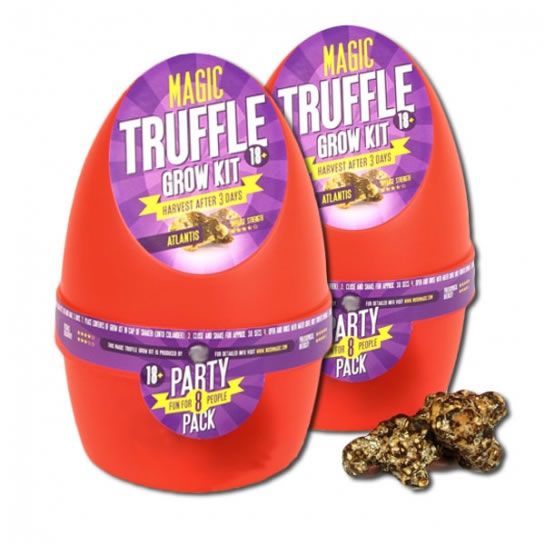
A container of substrate that is already colonised by mycelium, sold so that the buyer only has to provide the conditions for fruiting. In the Netherlands, selling and owning a mushroom grow kit is legal, but as soon as mushrooms appear the owner possesses paddos, and that is prohibited (DRUGSinfo). Truffle grow kits produce sclerotia instead, which fall outside the Opium Act.
Spore syringe
3 cross-referencesShow on the map
A syringe of sterile water with spores suspended in it, sold for microscopy and as a starting point for cultures. Spores contain no psilocybin, and many countries regulate them differently from mushrooms. Check the law where you live before you buy or use one.
Continue with the chemistry terms, which explain what the cap, the mycelium and the sclerotium actually contain.