"Magic mushroom" is a street and shop name for any fungus that contains psilocybin. Behind it sit one large genus, a handful of species that matter in practice, and a layer of trade names that say less than they seem to. This page defines those names one entry at a time and links each to the terms it depends on.
Botanical names are written in italics and follow the usual rule: genus with a capital, species in lower case, so Psilocybe cubensis, shortened to P. cubensis after the first mention.
Genus and species
Magic mushroom
3 cross-referencesShow on the map
An informal name for mushrooms that contain psilocybin and psilocin. Most belong to the genus Psilocybe, but the same compounds occur in several other genera. The name tells you nothing about the species, the strength or the legal status of what is in front of you.
Psilocybe
3 cross-referencesShow on the map
The genus that holds most psilocybin mushrooms, with more than 100 psychoactive species. The name combines the Greek psilós (bare) and kúbe (head), after the smooth, peelable skin of the cap. Elias Fries first described the group and Paul Kummer published the genus name validly in 1871. The spore print is typically lilac-brown to dark purple-brown (Wikipedia: Psilocybe).
Psilocybe cubensis
3 cross-referencesShow on the map
The species behind almost every cultivated magic mushroom and nearly every strain name on a grow kit. Franklin Sumner Earle described it from Cuba in 1906 as Stropharia cubensis; Rolf Singer moved it to Psilocybe in 1949. In the wild it grows on cow dung, sometimes horse or water buffalo dung, and on rich pasture soil. It has a persistent white ring on the stem and a purple spore print (Wikipedia).
Liberty cap
3 cross-referencesShow on the map
The common name of Psilocybe semilanceata, a small grassland species with a conical cap of 5 to 25 mm that ends in a sharp point. It grows in wet pastures, meadows and lawns across the temperate Northern Hemisphere, mostly in Europe, and lives on decaying grass roots instead of directly on dung. Fries described it in 1838 as Agaricus semilanceatus (Wikipedia). Liberty caps are picked in the wild, so mistaking another species for one is a real risk.
Psilocybe mexicana
3 cross-referencesShow on the map
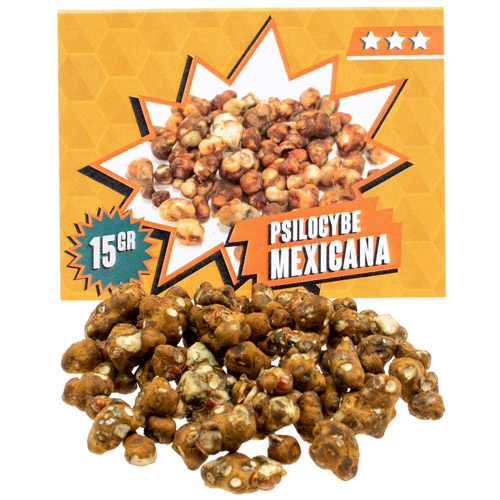
A small Mexican species, described by the French mycologist Roger Heim in 1957. In 1958 Albert Hofmann isolated and named psilocybin and psilocin from specimens grown in his Sandoz laboratory (Wikipedia). The species can form sclerotia, and Dutch-Smart describes its Mexicana truffles as fresh sclerotia of P. mexicana.
Psilocybe tampanensis
3 cross-referencesShow on the map
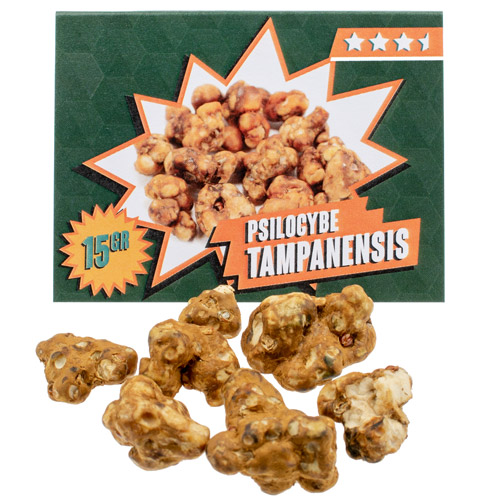
Found once in 1977, in a sandy meadow near Tampa, Florida, by Steven Pollock, and described with Gastón Guzmán in 1978. The species is very rare in the wild. In culture it forms sclerotia, which became known as philosopher's stones (Wikipedia).
Psilocybe atlantis
3 cross-referencesShow on the map
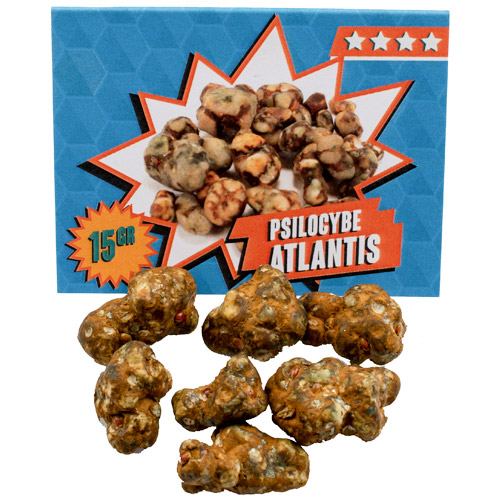
Described in 2003 by Guzmán, Hanlin and White (Mycotaxon 86: 179 to 183) from a lawn in Fulton County, Georgia, where it grew on moss near a tributary of the Chattahoochee River. It is a close relative of P. mexicana (Wikipedia). Truffles sold as Atlantis are sclerotia of this species, according to the shop.
Other genera
2 cross-referencesShow on the map
Psilocybin also occurs outside Psilocybe: in Panaeolus, Gymnopilus, Inocybe and Pluteus, and in a few species of Conocybe, Galerina, Mycena and Pholiotina (Wikipedia: Psilocybe). Some of those genera also contain dangerous species, so a genus name alone says little about safety.
Lookalike
3 cross-referencesShow on the map
A mushroom that resembles a psilocybin species but is a different one. The serious cases involve amatoxins: about 95 percent of mushroom deaths worldwide are caused by amatoxin-containing species, a group that includes Galerina autumnalis, G. venenata, G. sulcipes and Conocybe filaris (StatPearls, Horowitz and Moss). Lookalikes matter for wild picking. Cultivated kits and shop truffles avoid the problem of identification.
Names used in shops
Strain
3 cross-referencesShow on the map
A grower's and shop name for a line of one species, almost always P. cubensis, kept under a fixed label such as Golden Teacher, B+ or Mazatapec. Strains are cultivars within one species. A 2025 review notes that most strain descriptions come from "non-academic, community-based reports" and that cultivars with the same label "often lack genetic similarity across different suppliers" (Kurzbaum et al. 2025, J Fungi).
Magic truffles
4 cross-referencesShow on the map
The trade name for psilocybin-containing sclerotia, sold fresh in Dutch smartshops. They are firm lumps of mycelium that form underground; the Dutch public information site DRUGSinfo sums up the difference as mushrooms growing above ground and truffles below it. Because they are not mushrooms, they fall outside the Dutch Opium Act. A laboratory study of commercial truffles found only psilocybin, at 0.6 to 1.7 mg per gram of fresh truffle (Pellegrini et al. 2013).
Fresh truffles are legal to buy in the Netherlands for adults. They are meant for use there: do not take them across a border.
Philosopher's stones
4 cross-referencesShow on the map
A nickname for truffles, used first for the sclerotia of P. tampanensis and later for truffles in general. Dutch-Smart still sells its Tampanensis truffles as "also known as the Philosopher's Stones" and describes them as mild to moderate, with a reflective character.
The next topic covers the biology behind these names: how a spore becomes mycelium, and how mycelium becomes a mushroom or a truffle.